Case note · Deemed conveyance
On a single-building plot, deemed conveyance covers the whole land
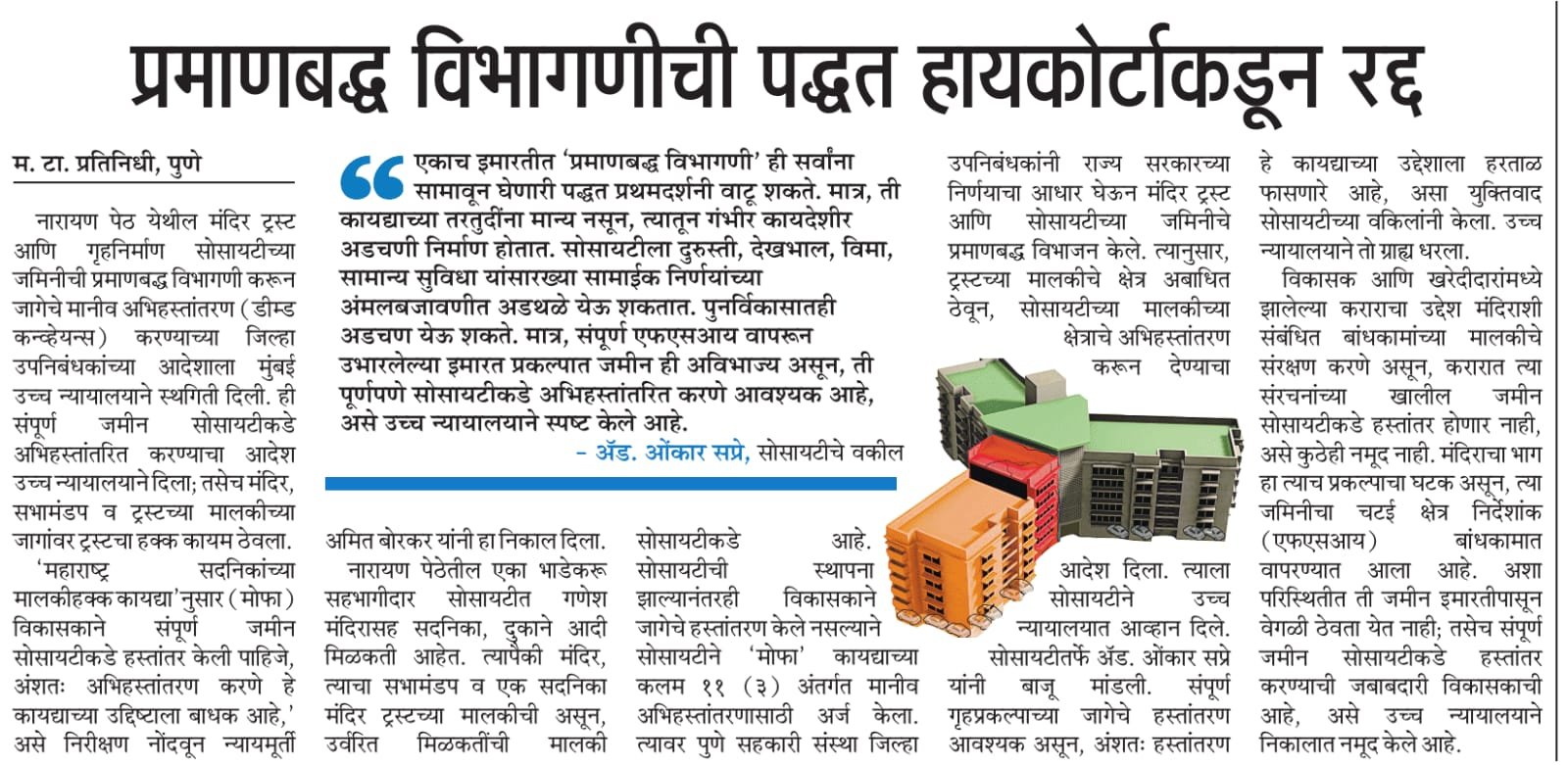
The Bombay High Court set aside a “proportionate” deemed conveyance that had left part of the plot with the original landowner’s trust, and directed conveyance of the entire land and building to the society.
Adv. Omkar M Sapre appeared for the petitioner society.
Key points
- Where a single building on a plot has used the FSI of the entire plot, the land beneath it is inseparable from the building. The promoter must convey the whole land to the society; it cannot be divided “proportionately”.
- Clauses in the Section 4 agreement that reserve certain constructed premises to a third party do not, by themselves, exclude the land beneath them from conveyance.
- Under Section 11 of MOFA, the competent authority must examine whether the entire land was used for the project. If it was, the full land area must be conveyed.
- The landowner’s trust keeps ownership of the structures reserved to it (the temple, Sabha Mandap and one flat). Only the land goes to the society.
The facts
Radha Vallabh Co-operative Housing Society Ltd. stands on a plot at Narayan Peth, Pune. The land belonged to a private trust. It was given for development, and a single building was constructed using the FSI of the whole plot. The building houses the society’s flats as well as a Ganesh temple with its Sabha Mandap and a flat belonging to the trust.
The flat-purchase agreements executed under Section 4 of MOFA contained Clause 35, which told purchasers that the temple, the Sabha Mandap and one flat “shall be the exclusive private property” of the trust. The trust is also a member of the society.
The society applied to the District Deputy Registrar, Co-operative Societies, Pune City (the competent authority) for unilateral deemed conveyance under Section 11(3) of MOFA — Application No. 462 of 2023.
The competent authority’s order
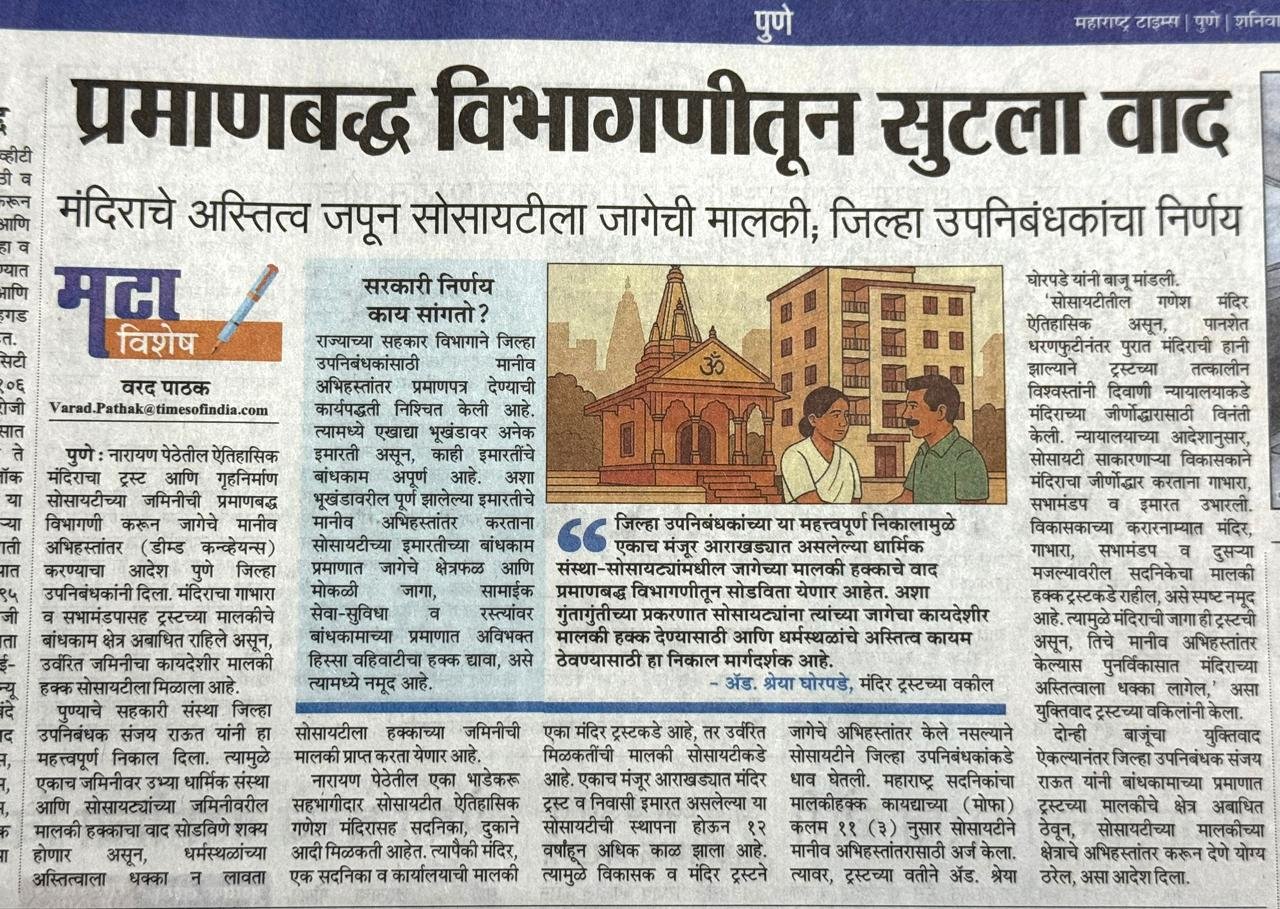
Relying on Clauses 34 and 35 of the agreement and on the Government Resolution of 2018 on deemed conveyance, the competent authority divided the property proportionately. It granted the society a certificate for only part of it, and left the balance with the trust:
What the High Court held
The society challenged the order in Writ Petition No. 566 of 2026. It was not disputed that MOFA applied and that Section 4 agreements had been executed. The Court held:
- Clause 35 deals with constructed premises, not land. It informs purchasers that certain premises belong to the trust and protects the trust’s ownership of them. It does not say the land beneath them is excluded from conveyance, or that the promoter will keep title to that land indefinitely. It cannot be read to cut down the society’s statutory right to the land.
- Single building, entire FSI used. The temple forms part of the same building, and the FSI of the whole plot was consumed in it. This is not a layout with several buildings. When a single building is developed using the FSI of the whole plot, the land becomes inseparable from the building, and the promoter cannot divide it afterwards to retain portions for himself or anyone else.
- The authority’s task under Section 11. The competent authority had to examine whether the entire land was used for the project. Once it was, the full land area had to be conveyed. Restricting the conveyance defeats the object of the Act, which is to secure complete transfer of title so that the society can manage and maintain the property.
- The trust’s structures are not disturbed. The temple, the Sabha Mandap and the trust’s flat remain the trust’s property, as the agreement says. Conveying the land to the society does not change that.
The order was quashed to the extent it rejected the balance land, and the competent authority was directed to issue, within four weeks, a fresh certificate of unilateral deemed conveyance for the entire 320.99 m² of land with the 730.94 m² built-up area.
How the matter moved
- 2023Application for deemed conveyanceApplication No. 462 of 2023 before the DDR, Pune City, under Section 11(3) of MOFA.
- 3 October 2025Partial deemed conveyanceCertificate for 278.84 m² of land and 633.37 m² of built-up area; the balance left with the trust.
- 17 March 2026Bombay High Court sets the order asideWP No. 566 of 2026: fresh certificate for the entire land and building to be issued within four weeks.
- 10 April 2026Fresh certificate issuedThe DDR, Pune City, issues a revised certificate of unilateral deemed conveyance in compliance with the High Court’s order.
Why it matters for societies
Many older buildings in Pune and elsewhere stand on land given for development by a family or a trust, which kept a temple, a shop or a flat for itself. When the society applies for deemed conveyance, the landowner often argues that “its” portion of the land must be carved out. This judgment makes the position clear for single-building plots: if the building has used the FSI of the whole plot, the whole plot goes to the society. The landowner’s ownership of its own premises is protected, but that is ownership of the premises, not of a separate piece of land.
The position may differ where the land forms part of a larger layout with several buildings, which the Court expressly distinguished.
In the press
Both stages of the matter were reported in Maharashtra Times (Pune edition).
Documents
The DDR’s orders are in Marathi; the account above is a summary, not a translation. This note describes one decided case for general information. The outcome of any matter depends on its own facts and documents. Nothing here is legal advice, and contacting the office does not create an advocate–client relationship.
Has your society’s conveyance been granted only in part?
Write to the office with a brief description of the matter. Meetings are by prior appointment.